The RTPs of Africa and G20: The Definitive Guide
The definitive guide to Real-Time Payment (RTP) systems in Africa & the G20. Learn how financial orchestration solves cross-border fragmentation.
AUG 26 - 5 MIN READ

Africa now moves money in real time at a scale that would have been implausible a decade ago. In 2024 the continent processed roughly 64 billion instant payment transactions worth about US$2 trillion, across 36 live systems in 31 countries. The rails work, the problem is what happens at the border.
Nigeria: NIBSS Instant Payment
Status: Operational
NIP is the continent's deepest real-time rail and the only African instant payment system AfricaNenda rates as mature. It moved 11.2 billion transactions worth N1.07 quadrillion in 2024, up from 9.7 billion and N600 trillion in 2023. Instant payment value now runs at roughly four times Nigeria's gross national income, the highest ratio on the continent.
Two things the market gets wrong. Nigeria is Africa's most populous country but, after the naira devaluations, its third-largest economy by nominal GDP, behind South Africa and Egypt, and the live story is not the eNaira, which the central bank has repositioned toward government disbursement and cross-border use under Payments System Vision 2028. It is infrastructural: NIBSS is migrating the country onto the National Payment Stack, an ISO 20022 platform that will eventually retire the NIP rail. Everyone integrated to NIP will re-integrate.
Kenya: PesaLink, inside a mobile money economy
Status: Operational
PesaLink is a bank-to-bank rail carrying large tickets, not a mass retail one: 8.41 million transactions worth KSh 1.1 trillion in 2024, at an average ticket of KSh 134,100, settling in about two seconds at 99.7% uptime across 80 connected institutions. Retail Kenya runs elsewhere. M-Pesa alone moved 46.4 billion transactions worth KSh 41.68 trillion in the year to March 2026.
That gap is the point. Kenya has bank rails and wallet rails, and the Central Bank of Kenya is still choosing who builds the national fast payment system that joins them, with three competing models on the table. Meanwhile PesaLink connected to PAPSS in February 2026, opening its participants to cross-border termination before the domestic question is settled.
South Africa: RTC for value, PayShap for volume
Status: Operational
Real-Time Clearing is one of the world's earliest instant rails and still carries corporate and high-value flow, with a R5 million ceiling. The growth story is PayShap, launched in March 2023, which passed one billion cumulative transactions and now runs above 60 million a month across twelve banks, with a R50,000 per-transaction limit raised from R3,000 in late 2024. Governance is shifting underneath both: the Reserve Bank withdrew recognition of the Payments Association of South Africa in August 2026 and took payment system management in-house. With 84% of adults banked, South Africa has the depth; what it has lacked is real-time share, which sat at under 2% of payment volume as recently as 2023.
Ghana: one switch, every rail
Status: Operational
Ghana runs instant transfer, mobile money interoperability, GhanaPay, a national QR standard and proxy addressing through a single national switch, alongside e-zwich and gh-link cards. Mobile money moved 8.1 billion transactions worth GH¢3.01 trillion in 2024, and by June 2026 there were 84.6 million registered wallets, 26.4 million of them active, served by more than a million agents. GhIPSS Instant Pay grew 233% in value in 2024.
Ghana's 2018 interoperability launch was not Africa's first, Tanzania had bilateral cross-network transfers in 2014, but it was the first hub-based model connecting wallets, bank accounts and a national card scheme through one switch, and it became the West African template. Parliament repealed the electronic transfer levy in March 2025, removing the tax friction that had suppressed wallet usage since 2022.
Egypt: the Instant Payment Network
Status: Operational
By November 2025 the IPN had passed 16 million registered users and roughly 1.1 billion transactions worth EGP 2.4 trillion, alongside 55.5 million mobile wallets and 43.5 million Meeza cards, with individual financial inclusion at 76.3%. Egypt is the corridor argument on its own: 109 million people and US$41.5 billion in remittance inflows in 2025, up 40.5% year on year, now the country's third-largest source of foreign currency.
Zambia: the National Financial Switch
Status: Operational
The NFS connects commercial banks, mobile money operators, microfinance institutions and non-bank payment providers on one real-time, 24/7 switch. It is the model for smaller markets building modern infrastructure without a legacy estate, and it has worked. Adult financial inclusion reached 80.1% in 2025, up from 69.4% in 2020, with 76.2% of adults using mobile money and the gender gap narrowed to just over two points.
The G20 rails Africa trades with
- UPI (India). 241.6 billion transactions worth ₹314 lakh crore in FY2025-26, across 703 banks, and roughly 49% of all real-time payment volume worldwide. No African market accepts UPI yet: Namibia's UPI-derived system, licensed from NPCI International in 2024, is now targeted at Q3 2026, and an agreed GhIPSS linkage is not live.
- Faster Payments (UK). 5.55 billion transactions worth £4.84 trillion in 2025. The New Payments Architecture programme was cancelled and rescoped; the Bank of England's Retail Payments Infrastructure Board now leads the successor design, with consultation closing September 2026.
- SEPA Instant (EU). Roughly 8.3 billion euro-area instant transactions in 2025, now 30.7% of SEPA credit transfer volume, across 41 countries and territories. Euro-area banks have been obliged to send instant payments and run Verification of Payee since 9 October 2025. Non-euro-area providers follow through 2027.
- Pix (Brazil). 79.8 billion transactions worth R$35.3 trillion in 2025, 148 million individual users covering 86% of Brazilian adults, and a single-day record of 313 million transactions.
What unites them, and what separates them
Every one of these systems is fast, denominated in local currency, and regulated by its own central bank. That is precisely why they do not connect. A Nigerian bank cannot integrate directly with UPI without an Indian licensed entity, rupee accounts and an NPCI integration. A South African platform cannot join SEPA Instant without a European entity, a payment institution licence, and the national variations that come with it.
Africa built world-class payment highways inside each country. The work now is the bridges between them.
The bridges being built, and the ones still missing
Africa is not waiting. PAPSS now reaches 28 countries, more than 190 banks and fintechs and 16 national switches, and its African Currency Marketplace, launched in 2025, exchanges African currencies directly rather than routing through dollars, addressing an estimated US$5 billion a year in hard-currency bottleneck costs. Intra-African trade reached US$220.3 billion in 2024, about 14.7% of Africa's total, with Afreximbank projecting roughly 16% in 2026.
The external corridors, sized honestly: EU-Africa goods trade of €355 billion in 2024, India-Africa merchandise trade of about US$83 billion in FY2024-25, Brazil-Africa trade of about US$24 billion, and remittances into Africa of roughly US$95 to 104 billion. Each one crosses a different regulatory regime, a different currency, and a different technical standard. A company paying suppliers across ten African markets and five G20 economies would traditionally need ten to fifteen local entities, as many banking relationships, and a compliance function in each. That is not scale, that is operational debt.
How Passpoint connects them
Passpoint is a financial orchestration layer. It does not replace national rails, which work well inside their borders. It makes them usable from outside. One integration gives enterprises, fintechs and platforms access to the major African instant payment systems and the G20 corridors that matter, across 54+ countries, 42 corridors and 30+ payment methods, under one contract.
- Dynamic routing. Every transaction is evaluated and routed on your priority: lowest cost, fastest settlement, highest success rate or best FX.
- Local currency settlement. Customers pay in naira, shillings, rand, rupees or euros. You receive settlement in your preferred currency, converted at interbank rates.
- Embedded compliance. Passpoint orchestrates payments and compliance together. KYC, AML and sanctions screening run natively in the API, through licensed entities in the markets covered, so you do not incorporate locally or staff a compliance team per country.
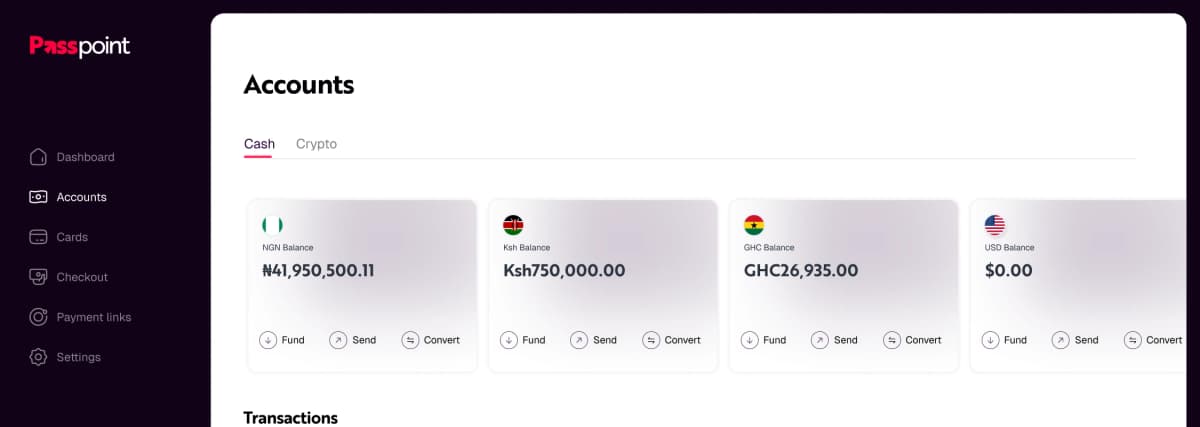
- Real-time visibility. Monitor, reconcile and control every transaction across every market from one dashboard.
Go-live takes five days, not the twelve to eighteen months a market-by-market build requires. With a single integration, banks, wallets, and can make worldwide payments instantly through our API.
Passpoint Team
We are the team behind the real-time cross-border payments infrastructure for Africa and the world. We write about RTP systems, interoperability, and the region's financial ecosystem.