Paystack vs Flutterwave vs Passpoint: Which Is Right for Your Business?
Paystack, Flutterwave, and Passpoint are not the same category of infrastructure. This comparison explains what each one is actually built for, where each one has a ceiling, and which is right for your specific use case.
MAY 07 - 5 MIN READ

Businesses comparing Paystack, Flutterwave, and Passpoint are usually in one of two situations. Either they are early-stage and trying to understand the landscape before making a first integration decision, or they are scaling and have begun to feel the ceiling of their current payment infrastructure without being able to articulate why.
Paystack and Flutterwave are good products that are right for specific use cases. Passpoint is a different kind of infrastructure built for a different set of use cases. The difference is not about better reviews or lower transaction fees. It is about what layer of the payment stack each one operates at, and which layer your business actually needs.
What Paystack Is
Paystack is a payment gateway founded in Lagos in 2015 and acquired by Stripe in 2020. It is one of the most well-regarded payment products in Africa, known for developer-friendly documentation, reliable uptime, and a clean integration experience.
Its core product is payment acceptance for businesses collecting from Nigerian customers, with expansion into Ghana, South Africa, Kenya, and a small number of other African markets. It handles cards, bank transfers, USSD, and mobile money in those markets.
Paystack serves best the businesses operating primarily in Nigeria, collecting from Nigerian consumers, at volumes where a single-market gateway integration is sufficient. For a Nigerian e-commerce business, a SaaS company selling to Nigerian customers, or an early-stage startup, Paystack is an excellent choice.
The ceiling appears in three forms. Geographic: when the business needs markets Paystack does not support. Operational: when single-provider reconciliation, settlement, and compliance tracking become a material burden. Infrastructural: when the business needs treasury management, FX orchestration, embedded compliance across multiple jurisdictions, or card issuance.
What Flutterwave Is
Flutterwave is a payment infrastructure company founded in 2016, with broader geographic coverage than Paystack and a product suite that extends into payment links, invoicing, and multi-currency accounts.
Its core value proposition is African market breadth. It supports more African markets than Paystack and has invested in coverage across West, East, and Southern Africa. For businesses that need multi-market African payment acceptance through a single provider relationship, Flutterwave has historically been the obvious option.
The ceiling overlaps with Paystack's. Geographic coverage is broader, but coverage depth in specific markets, the quality of local rail access, success rate performance, and local compliance posture varies. Businesses operating at genuine scale frequently find that breadth and depth are different things. Both products are payment gateways, and neither is designed to be the compliance and treasury infrastructure layer for a business operating across multiple regulated jurisdictions simultaneously.
What Passpoint Is
Passpoint is not a payment gateway. This is the most important thing to understand before comparing it to Paystack or Flutterwave, because putting them in the same category misframes what each one is for.
Paystack and Flutterwave accept payments on specific rails in specific markets and settle funds to merchant accounts. Passpoint is a financial orchestration layer. It sits above the rails. It governs how payments move across multiple rails and providers, manages FX across multi-currency positions, embeds compliance logic across multiple regulatory jurisdictions, and provides unified operational control across the full payment stack. It is infrastructure for businesses that have outgrown the gateway model.
Passpoint is not a replacement for Paystack in the sense of doing the same thing at lower cost. It replaces the combination of multiple gateways, manual FX management, market-by-market compliance processes, and fragmented reconciliation workflows that businesses accumulate as they scale.
The Dimensions That Matter
Geographic depth versus breadth. Paystack is deep in Nigeria. Flutterwave is broad across African markets with depth varying by market. Passpoint operates in select high-impact corridors across Africa and the G20, including Nigeria, Kenya, Tanzania, Uganda, Cameroon, the XOF region, Europe, the UK, China, and the United States, with genuine licensed infrastructure in each market rather than routed access through sub-partners.
Compliance. Paystack and Flutterwave handle their own compliance as licensed gateways. Merchant compliance responsibilities remain with the merchant. Passpoint holds direct licences from the Central Bank of Nigeria, operates under FINTRAC in Canada, and provides PSD2-compliant infrastructure across 24 EU countries and the UK. Compliance logic for KYC, AML, transaction monitoring, and regulatory reporting is embedded in the payment layer rather than managed separately per market.
FX management. Paystack and Flutterwave settle in supported currencies with provider-determined FX. Passpoint provides multi-currency balance management across African and G20 currencies, real-time visibility into FX positions, institutionally sourced rates in African corridors, and merchant control over conversion timing.
Routing intelligence. Paystack and Flutterwave operate fundamentally as single-provider models for each transaction. Passpoint provides multi-provider routing with real-time performance data, configurable optimisation across success rate, cost, speed, and compliance, and automatic fallback when primary routing paths fail.
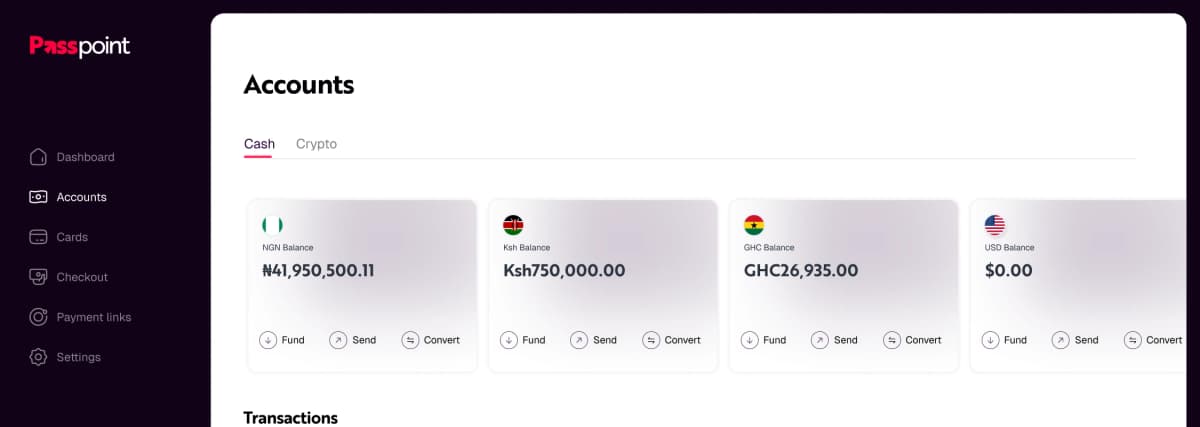
Treasury and operational control. Passpoint provides unified operational control across all markets and currencies, with real-time visibility into payment activity, settlement positions, FX exposure, and compliance status in a single dashboard.
The Use Case Map
If you are a Nigerian startup that needs to start accepting payments from Nigerian customers quickly, Paystack is the right choice.
If you are an African business operating in three or four markets and need a single provider relationship that covers your current footprint, Flutterwave is worth evaluating, alongside a clear-eyed assessment of its depth in your specific markets.
If you are a scaling business with payment operations across multiple African markets and the G20, and the combination of engineering maintenance, reconciliation overhead, compliance complexity, and FX management is consuming operational capacity that should be going toward growth, Passpoint is built for this situation.
If you are a global business entering African markets for the first time and want to do it without building a separate compliance and payment integration for every new corridor, Passpoint's single integration model changes the market entry economics.
If you are building a fintech product that requires card issuance alongside payment collection and cross-border payouts, Passpoint provides all three through a single integration and a single compliance framework.
The Honest Assessment
Paystack and Flutterwave have built genuinely good products that serve real needs well. Businesses at the right stage and with the right use cases should use them.
The limit is also clear. They are payment gateways. When a business grows beyond what gateways are built for, it is not that the gateway has failed. The business has outgrown the gateway model.
Passpoint is built for what comes after. Not as a bigger gateway, but as a different category of infrastructure entirely: a financial orchestration layer that governs payment operations rather than processing individual transactions.
The businesses that recognise this distinction earliest, and make the transition before the operational cost of the gateway model becomes a genuine constraint, are the ones building the most durable payment operations in African and global markets.
If the description of the Passpoint use case resonates with where your business is today or where it is heading in the next twelve months, the right next step is a conversation with the Passpoint team. Start that conversation at mypasspoint.com