What is Financial Orchestration?
Financial orchestration gives global businesses one control plane for payments, settlement, reconciliation, and compliance — replacing fragmented PSP stacks with One API, One Contract.
MAY 07 - 5 MIN READ

As a business, you don’t wake up one morning and decide you “need orchestration.”
You get forced into it.
- You’re expanding into new countries and discovering that every market is its own banking stack—its own processors, payment methods, settlement rules, and compliance demands.
- You’re juggling more PSPs and local partners than ever, and payment operations has quietly become a second engineering team.
- You’re comparing “orchestration platforms,” but most of what’s being sold is a prettier dashboard on top of the same fragmentation.
This article breaks down what orchestration really is, how it works in practice, and how to evaluate platforms when you’re serious about scale—not just adding one more payment method.
We’ll cover:
- What Financial Orchestration is (and why “payment orchestration” is too small a frame)
- Why fragmentation exists, and why it’s getting worse
- The real benefits: authorization lift, resilience, cost control, and compliance leverage
- What to look for in an orchestration layer
- Why Passpoint: One API. One Contract. 54 markets.
What is Financial Orchestration?
A Financial Orchestration Layer consolidates all the integrations required to move money reliably; acquirers, wallets, bank rails, payout partners, FX, fraud controls, and compliance checks—behind a single interface.
Think of it as the control plane for money movement.
With orchestration, you can:
- present the right payment methods by country and customer context
- route transactions across providers using rules you control
- fail over automatically when a rail goes down
- reconcile and report across providers without stitching spreadsheets together
- enforce compliance as logic, not as an after-the-fact manual process
“Payment orchestration” typically stops at checkout. Financial orchestration covers the full lifecycle: accept → route → settle → reconcile → report → comply.
Why does orchestration exist (and how does it work)?
Because the global payments ecosystem didn’t evolve as one system—it evolved as a thousand local systems.
Each new market adds:
- different regulations
- different rails and uptime realities
- different fraud patterns
- different data formats
- different settlement behavior
This is why “just integrate another PSP” never stays simple.
Here’s how orchestration works in a real payment flow:
- Customer checks out and selects a payment method (card, wallet, bank transfer, local APM).
- Passpoint captures and tokenizes payment data, applies your policies, and standardizes the request.
- The transaction is routed based on your rules (country, BIN, issuer behavior, cost, success rate, risk profile, currency, SLA).
- If Provider A fails or degrades, Passpoint triggers fallback routing to Provider B.
- The acquirer/rail completes authorization and settlement with the issuing bank/network.
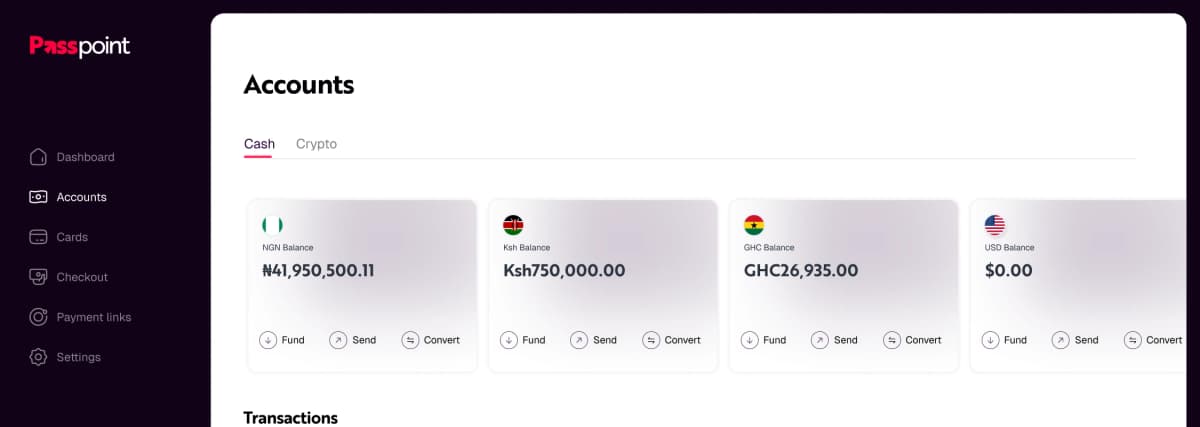
- You get a unified view of performance, exceptions, and reconciliation, across every provider, market, and method.
And critically: the rules live with you, not inside a PSP portal.
Benefits of orchestration (the ones that show up in your P&L)
1) Faster expansion: launch countries without rebuilding your stack
Without orchestration, each new corridor is a bespoke integration + contract + operational playbook. With orchestration, expansion becomes configuration.
2) Higher authorization rates through intelligent routing
Orchestration lets you route by the attributes that actually drive outcomes: issuer behavior, provider strengths by corridor, risk level, and time-of-day reliability.
3) Resilience: automatic failover when rails break
Downtime happens—especially in complex markets. Orchestration means you don’t lose revenue just because a single provider is having a bad day.
4) Lower cost through transaction-level optimization
You can route to the lowest-cost option per transaction while balancing approval rates and fraud controls.
5) Stronger fraud posture with adaptive controls
Orchestration allows step-up authentication (like 3DS) only when needed, and consistent fraud/compliance logic across providers.
What to look for in an orchestration platform
If you’re evaluating vendors, don’t start with feature lists. Start with the question:
Who controls the system—your business, or the vendor?
Here are the non-negotiables:
- One integration that stays stable If you still have to manage multiple schemas, you don’t have orchestration, you have aggregation.
- Policy-driven routing (not “smart routing” you can’t audit) You should be able to define, test, and govern routing logic like a treasury policy.
- A real vault and portability Tokenization is only useful if it lets you move providers without re-collecting credentials.
- Unified reconciliation + observability If you can’t see performance and settlement across providers in one model, you’re still flying blind.
- Compliance-as-Code The future is automated enforcement: controls embedded in flows, not manual “ops checks” after money moves.
Why Passpoint
Traditional PSPs optimize their own lane. Legacy banks optimize their own balance sheet. Passpoint optimizes the system.
Passpoint is built around a single premise:
One API. One Contract.
So you can orchestrate across markets without rebuilding legal, technical, and operational infrastructure every time you expand.
And here’s the real stress test: Africa.
If a system can reliably orchestrate 54 African markets—fragmented rails, volatile liquidity conditions, heavy compliance variance—then the G20 becomes a rounding error.
That’s the point of Passpoint: not “more payment methods,” but financial sovereignty at scale.