Africa's Cross-Border Payments Need Governance, Not More Management
African financial institutions still rely on correspondent banking for cross-border payments. The real-time rails already exist. What's missing is the decision to connect them.
JUL 31 - 5 MIN READ

The correspondent banking model that most African financial institutions use to serve their customers' cross-border payment needs was not designed for African commerce in 2026.
It was designed for a world where settlement timelines of three to five days were an accepted constraint, where the primary participants in international finance were large institutions in developed markets, and where Africa was an afterthought in the architecture rather than one of the fastest-growing commercial regions in the world.
That world has changed. The correspondent banking model has not.
African banks and financial institutions that continue routing their customers' cross-border payments through multi-tiered correspondent chains are not just absorbing operational overhead. They are actively losing customers, margin, and market position to infrastructure companies that built real-time cross-border rail access from scratch rather than inheriting systems that were never designed for the markets they now need to serve.
The status quo is not sustainable. The question is whether African financial institutions break it proactively or have it broken for them.
What the Status Quo Actually Costs
The cost of correspondent banking for African cross-border payments shows up in three places simultaneously.
For the customer it is visible in settlement speed, cost, and transparency. A payment initiated on Monday to pay a Kenyan supplier arrives Thursday or Friday. The cost is higher than it should be because each correspondent bank in the chain extracts margin before passing the payment to the next participant. And the transparency is worse than it should be because data that was structured at origination degrades at each step of the chain.
For the institution the cost shows up in retention and margin. A Nigerian business that finds its cross-border payment needs better served by a fintech offering real-time settlement at lower cost through direct local rail access does not stay with the bank offering three-day correspondent settlement at a premium. It moves. And it typically moves its domestic business with it.
The FX margin erosion compounds both. The spread applied inside the correspondent chain is determined by correspondent institutions rather than by the competitive market for that currency pair. African financial institutions routing cross-border payments through correspondent chains are subsidising the FX margins of those institutions rather than capturing them.
The Real-Time Rails Already Exist
The argument for moving away from correspondent banking for African cross-border payments is not about waiting for new technology. It is about connecting to technology that already exists.
NIP in Nigeria settles interbank transfers in seconds. M-Pesa in Kenya has been processing mobile money transactions faster than any correspondent chain since 2007. The mobile money networks across the XOF region move value across eight countries. PIX in Brazil and UPI in India have demonstrated that real-time payment infrastructure at national scale is achievable across markets of every size.
These rails are mature, trusted, and deeply embedded in the commercial lives of the businesses and consumers who use them. They are almost entirely disconnected from each other across borders not because the technology does not exist but because the layer connecting them was never built by the incumbent institutions that benefit from the correspondent chains currently routing traffic between them.
The direct alternative routes a payment from a Nigerian bank account to a Kenyan mobile money wallet through a connectivity layer that accesses NIP on the Nigerian side and M-Pesa on the Kenyan side, without the USD intermediate step, without the correspondent bank fees, and without the multi-day settlement timeline.
The bank that can tell its business customers their cross-border payment to Kenya will arrive same day at meaningfully lower cost has a product differentiation that is real and durable. Not cosmetic.
What the Transition Looks Like
The African financial institutions breaking the correspondent banking status quo are not building direct rail access themselves. They are connecting to an orchestration layer that has already built it.
A single API integration connects the institution to direct rail access across African and G20 corridors, with intelligent routing that selects the optimal path per transaction, embedded compliance that applies the right regulatory framework automatically, and institutional FX rates rather than correspondent chain spreads.
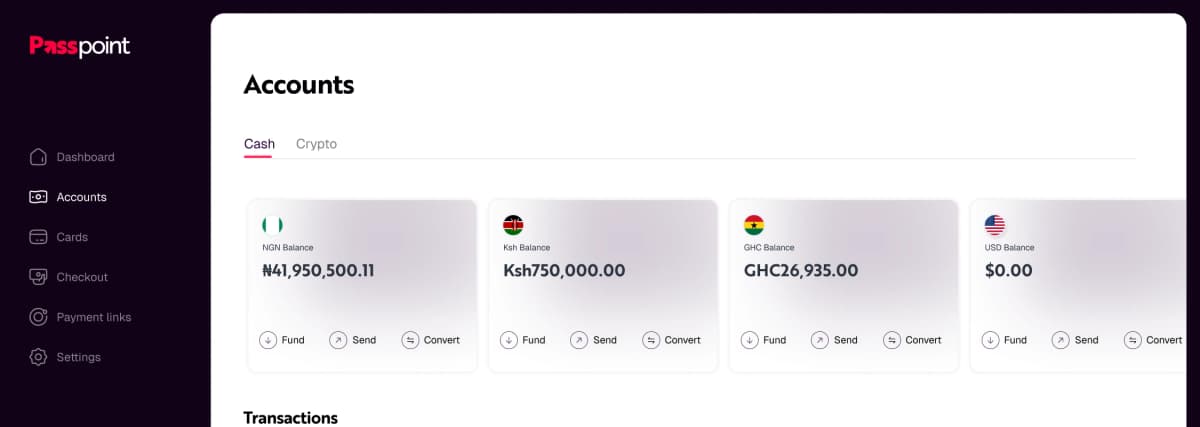
Passpoint is that layer. Forty-two corridors across Africa, Europe, and the G20. Direct integration with NIP in Nigeria, M-Pesa in Kenya, mobile money operators across East and West Africa, open banking across 24 EU countries and the UK, the full USD rail stack in the United States, and USDC and USDT on-ramp and off-ramp across African corridors. Single API. Embedded compliance. Institutional FX.
The correspondent banking status quo has served African financial institutions adequately for a long time. Adequately is no longer a competitive standard when their customers can access real-time cross-border settlement through a fintech that takes weeks to integrate rather than years to build.
The institutions that break the status quo now will define the competitive landscape of African cross-border payments. The ones that wait will find it defined for them.